The clinical and preclinical evidence supporting NaNotics' approach —
from the Immune Pheresis precedent to preclinical mouse data.
In the 2000s, a visionary clinician – M. Rigdon Lentz, MD – showed that cancer can be treated with unparalleled efficacy by depleting soluble TNF receptors (sTNF‑Rs) from patients' blood. Dr. Lentz's treatment, called Immune Pheresis, was capable of regressing even late-stage cancer.
Immune Pheresis was a purely subtractive monotherapy — no drugs or other adjunctive treatments were involved. The treatment was assessed in 100+ patients with 20+ solid-tumor cancer types, and was the subject of a clinical trial resulting in a CE Mark in 2008.
Immune Pheresis used a complex, lengthy, and invasive apheresis procedure — limiting its reach to a small number of patients who could travel to Dr. Lentz's clinic in Germany. Insights from Immune Pheresis inspired development of NaNots — the first therapeutic to clear sTNF‑Rs via simple injection, enabling a new globally-scalable treatment.
Immune Pheresis results: 60%
Overall Response Rate (ORR)
(typical new investigational drug
monotherapies have ORRs of ≤ 10%)
The data above for 5 tumor
types are extracted from a
data set of 20+ tumor types.
| Cancer Type | # Responses | Total N | Response % |
|---|---|---|---|
| Breast | 20 | 27 | 74% |
| Lung | 6 | 13 | 46% |
| Ovarian | 3 | 4 | 75% |
| Prostate | 8 | 8 | 100% |
| Sarcomas / soft tissue | 6 | 7 | 86% |
All patients late-stage metastatic. Detailed summary & data available under NDA.
The data above for 5 tumor
types are extracted from a
data set of 20+ responding tumor types.NOTE: The above data for 5 tumor types is extracted from a data set of 20+ tumor types.The above data for 5 tumor types is extracted
from a data set of 20+ tumor types.

Dr. Lentz treats a cancer patient with Immune Pheresis (2014)Dr. Lentz treats a cancer patient with Immune Pheresis (2014)Dr. Lentz treats a cancer patient with Immune Pheresis (2014)
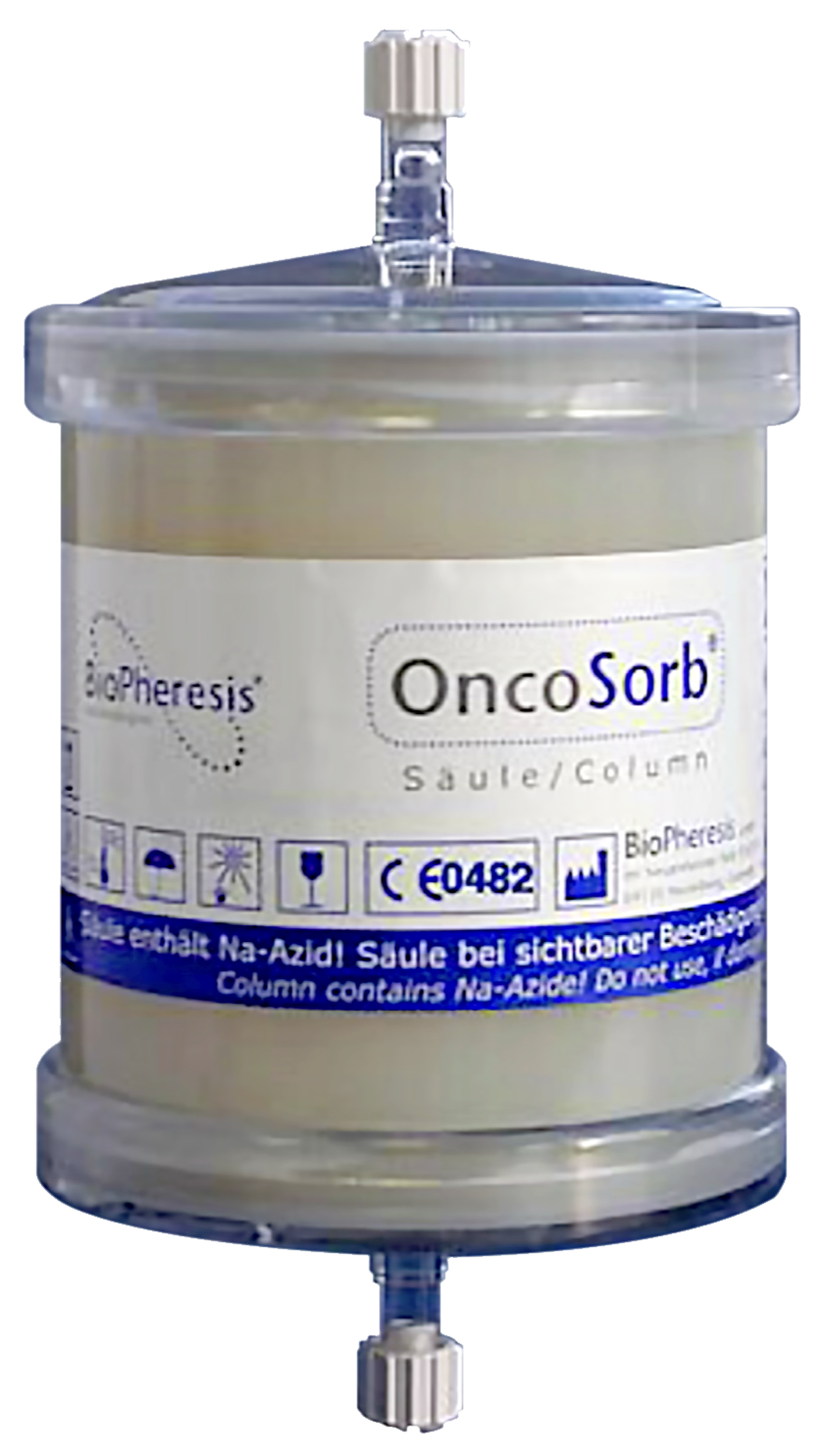
The Immune Pheresis device incorporated a pair of affinity columns, which captured sTNF‑Rs from patient plasma. The "cleaned" plasma – minus only these immune inhibitors – was then returned to patient circulation.

It’s useful to compare Immune Pheresis efficacy data with the pembrolizumab (Keytruda®) Phase 1 trial data (Patnaik et al, 2015). Keytruda is currently the best-selling oncology drug by a wide margin (2025 sales: $31.7B). Viewing sTNF‑R depletion data alongside Keytruda Phase 1 data creates a like-for-like comparison of patients with a broad spectrum of advanced/metastatic tumor types, all having failed all approved therapies, with treatment applied as a monotherapy.
As shown on the rightin the table below, Keytruda’s Phase 1 data fell far short of sTNF‑R depletion via Immune Pheresis both in terms of breadth of responsive cancer types as well as the degree of response achieved.
Almost all objective responses to Keytruda were accounted for by patients with melanoma – among the most responsive cancer types to anti-PD-1 treatment – with one additional response in the highly immunogenic Merkel cell carcinoma. Removal of melanoma/Merkel cell patient data from both the Keytruda and sTNF‑R depletion cohorts demonstrates an even more striking degree of efficacy in the sTNF‑R depletion cohort (60% ORR, 22% CR) and none (0% ORR, 0% CR) in a similar breadth of tumor types in the Keytruda cohort.
| Keytruda Ph1 (Merck) | sTNF‑R Depletion (Immune Pheresis) | |
|---|---|---|
| # Patients | 30 | 102 |
| Performance Status | ECOG 0–1 (healthiest) | ECOG 0–3 (incl. very sick) |
| Complete Response (CR) | 6% | 23% |
| Overall Response (ORR) | 16% | 60% |
| CR excl. Melanoma/Merkel | 0% | 22% |
| ORR excl. Melanoma/Merkel | 0% | 60% |
Given that NaNots do the same thing as Immune Pheresis – clear sTNF‑Rs from circulation, just more rapidly and deeply – we expect comparable – or better – efficacy from NaNots.
NaNots against sTNF‑Rs were tested in a mouse model of triple negative breast cancer (TNBC) — a cancer refractory to virtually all approved therapeutics, including checkpoint inhibitors.
The NaNot cohort had 5× the number of metastasis-free survivors compared to both saline control and anti-PD-1 (mouse "Keytruda") cohorts.
Control and antibody cohorts each had 1 of 10 metastasis-free survivors at study end (D16). The NaNot cohort had 5 of 10, showing that NaNots against sTNF‑Rs induce immune attack on tumors in metastatic TNBC — just like Immune Pheresis.
Results demonstrate that NaNots against sTNF‑Rs induce immune attack on tumors in metastatic TNBC — just like Immune Pheresis.
NaNots Against sTNF‑Rs Outperform Checkpoint Inhibitor
Mouse Model of Triple Negative Breast Cancer (TNBC)Mouse Model of Triple Negative Breast Cancer
% metastasis-free survivors
Control
(Saline)
anti-PD-1 mAb
(mouse “Keytruda”)
NaNots
(anti-sTNF‑R)
The NaNot cohort had 5X more metastasis-free survivors vs.
control & anti-PD-1 mAb (each 1/10) at study end (D16)
NaNotics is collaborating with Mayo Clinic on anti-sPD-L1 NaNots for solid tumors. sPD-L1 is the soluble form of membrane PD-L1, secreted by many tumor cell types. It inhibits immune attack by binding inhibitory PD-1 receptors on immune cells. Plasma levels correlate very negatively with survival.
"The ability to deplete sPD-L1 without incurring the toxicity of drugs against PD-L1 is potentially significant. We're excited to collaborate with NaNotics and test NaNots against sPD-L1 in humans for the first time."
— Sean Park, MD, PhD
· Faculty / Oncologist, Mayo Clinic— Sean Park, MD, PhD
Faculty / Oncologist, Mayo Clinic
Our work demonstrates that selective capture of tumor-derived sPD-L1 with a novel nanotherapeutic platform can elicit local and systemic antitumor immunity.
— SITC 2023 Poster Abstract prepared by the Mayo team
A collaboration between: