Deep Dive · Science

Science

The science that underlies how NaNots work involves three3 key concepts:

1
Soluble Proteins are Central to
Health & Disease
Read more ↓
2
Certain Soluble Targets are
"Linchpins" of Disease
Read more ↓
3
MESH Targets are Undruggable
but Subtractable
Read more ↓
Concept One
1

Soluble Proteins are Central to Health & Disease

Click a blue square below to learn more about that target. Click the yellow or red square to learn about these drugs. Or click a NaNot outlined in green. Click a blue square below to learn more about that target. Click the yellow or red square to learn about these drugs. Or click a NaNot outlined in green to learn its function.
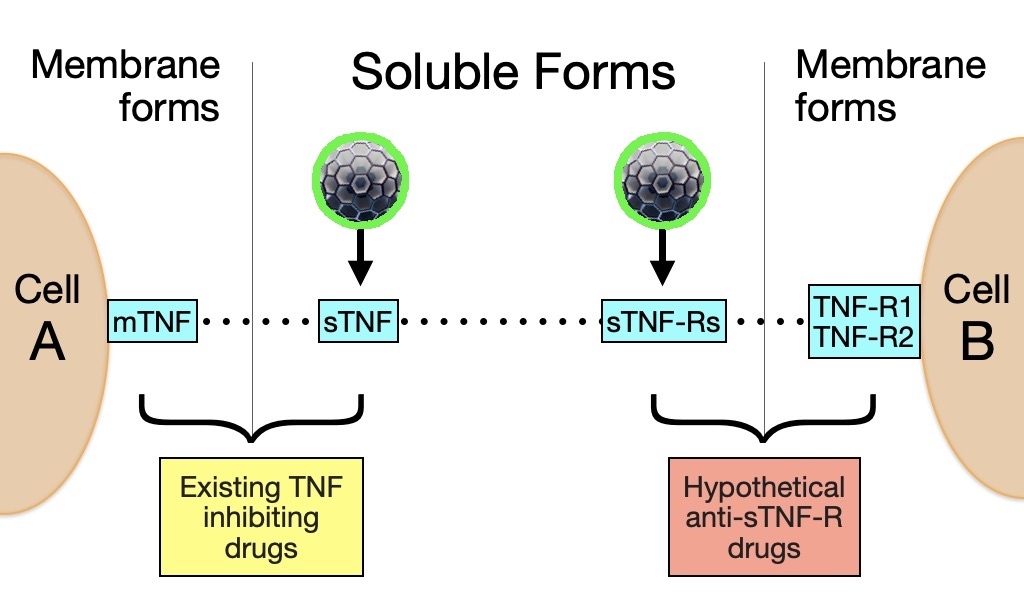
TNF Signal Axis diagram

Click a shape above to learn more.

Organisms possess natural signaling networks that maintain healthy biological processes, using soluble protein messengers to communicate between cells. Dysregulated signaling that drives or enables life-threatening diseases such as cancer and sepsis often manifests as an excess of one or more soluble proteins.

And yet, conventional pharmacology usually treats disease via addition of synthetic agents to the system – without correcting the underlying target excess. This often leads to ineffective – even toxic – outcomes.

NaNots deplete – literally subtract – the pathogenic excess of a soluble disease driver. Systemic reduction leads to target reduction in tissue compartments and resolution of disease – without the negative effects that stem from addition of conventional drugs.

Three powerful soluble signals lie between membrane TNF (mTNF) and membrane TNF receptors (TNF-R1 & TNF-R2). These signals are soluble TNF (sTNF) and soluble TNF-receptors – sTNF‑Rs. sTNF, like sTNF-Rs, is a MESH target. In inflammatory disease, sTNF drives inflammation while mTNF promotes resolution of inflammation and tissue regeneration. sTNF‑Rs block anti-cancer immunity and also oppose mTNF-driven regeneration. The NaNot ability to deplete either sTNF or sTNF‑Rs selectively provides broad, safe control over this signal axis, enabling novel treatments for serious diseases.

Another key soluble target active in cancer immune evasion is sPD-L1 – the soluble form of membrane PD-L1. Many tumor types secrete sPD-L1, the subject of our collaboration with Mayo Clinic (see Validation). We have preclinical data showing profound tumor suppression in partially humanized mouse models of cancer, stemming solely from depletion of this target via NaNot.

Concept Two
2

Certain Soluble Targets are “Linchpins” of Disease

Cart wheel with axle linchpin — illustrating how a single linchpin target can drive disease

Pulling Linchpin targets from blood can stop disease progression – the way a wheel falls off a cart when the axle linchpin is pulled.

Serious diseases with significant unmet need – including cancer, sepsis and neurodegenerative diseases – often involve dozens of dysregulated signals and cells.

However, not all soluble signals in a dysregulated network are of equal significance. Some are "linchpin" targets, meaning they play a central role in a given disease. Pulling these targets specifically from blood can interrupt disease progression, the way a wheel falls from a cart when the axle linchpin is pulled.

NaNots are a "programmable" platform – the capture agents inside NaNots can be easily swapped to change targets, diseases or even species – facilitating linchpin target exploration in vitro, in animal models and in our target species: human and canine. More information about our canine oncology program can be found at NaNotsForDogs.com.

NaNots were originally invented to address sTNF‑Rs, an undruggable linchpin target in cancer. NaNots are uniquely suited to address a broad class of soluble targets involved in multiple serious diseases – targets we call MESH.

Concept Three
3

MESH Targets are Undruggable but Subtractable

M
Membrane
Form of dual target attached to cell membrane
E
Essential
Membrane form is essential for healthy functionMembrane form has an essential function
S
Soluble
This form circulates freely in blood or tissue fluidCirculates freely in blood or tissue fluid
H
Harmful
The elevated soluble form drives the pathology

MESH stands for "Membrane Essential, Soluble Harmful". Proteins involved in health and disease often have two forms: a "membrane" form on the surface of a cell which is essential for health, and a "soluble" (shed or secreted) form of the same target, which is a disease driver when elevated. These dual forms of MESH targets usually convey opposing biological effects, making their distinction critical for therapeutics.

Many soluble MESH targets are well-established drivers of disease; others are commonly (sometimes erroneously) viewed solely as biomarkers. sTNF‑Rs are the soluble MESH target that NaNots were first designed to deplete for treating cancer. Another major example is TNF, which has a membrane form that’s essential for homeostasis and recovery from disease, and a soluble form that, when elevated, drives various inflammatory pathologies.

Conventional drugs – such as antibodies – rely on affinity for specific sites on the extracellular portions of their targets. Such drugs cannot distinguish soluble from membrane forms of MESH targets, which share the same binding sites. TNF inhibitors, for example, bind and inhibit mTNF as well as sTNF, resulting in adverse side effects such as loss of immune control of infection, loss of homeostatic anti-inflammatory mechanisms, and loss of myelin regeneration in multiple sclerosis.

NaNots are designed to distinguish between soluble and membrane MESH targets, using a unique combination of chemistry and patented geometry – thereby avoiding ineffective and toxic outcomes from indiscriminate neutralization of MESH targets.